From drone interest to professional UAS readiness.
CareerVector gives schools two ways to support UAS learners. Career Exploration helps students understand the industry and choose a direction. Career Pathway helps prepared students practice professional Mission work and produce evidence of competency and readiness.
Part 107 is a milestone, not the finish line.
From exploration to professional readiness — one connected path.
CareerVector is not a single workshop. It is a progression that helps students move from curiosity toward professional readiness. Career Exploration and Career Pathway are two entry points within that larger path — equal starting points, not a sequence students must climb in order.
Career Exploration
Discover professional UAS work, roles, and the mission thinking behind real operations.
Career Pathway
Apply knowledge through complete professional mission cycles, documentation, and review.
Mission + Readiness Experiences
Complete structured professional missions under realistic conditions.
Professional Evidence
Produce mission plans, risk assessments, and portfolio-ready work products.
Higher Education · Internships · Mentorship · Employment
Take credible next steps toward further training or work.
Choose a direction.
For students still discovering the UAS industry. An introduction to professional UAS work, roles, and the mission thinking behind real operations.
Build demonstrated readiness.
For students ready to apply knowledge in a professional setting. Built on Readiness Core plus Mission Modules — students move through complete professional mission cycles, not isolated drone exercises.
Custom district, multi-school, sponsored, and partnership implementations are available. Early Career Pathway engagements may run as pilots or co-design collaborations — but a pilot is a delivery stage, not the Career Pathway product.
CareerVector Readiness Lab
A facilitator-led, half-day professional UAS career-readiness experience for one student cohort. Students enter a realistic Mission, make a team recommendation, defend their reasoning, and connect the work to roles beyond pilot.
- One cohort of up to 20 students
- Approximately 2.5–3 student-facing hours
- CareerVector facilitator, materials, educator debrief, and brief cohort summary
- Optional app use; no live flight required
- Normal local travel included
No integration. No semester commitment. No custom curriculum required.
Larger, multi-cohort, custom, and Career Pathway engagements are scoped separately.
See CareerVector in action.
CareerVector is now a working student, educator, and program environment built around realistic UAS Missions, practical experience, educator review, and evidence of professional readiness. Watch the walkthrough for a look at the current model, or review the Positioning Overview for the program structure at a glance.
CareerVector Positioning Overview
A concise four-page overview of Career Exploration, Career Pathway, student and school value, program structure, and the professional operating experience behind CareerVector.
A certificate proves knowledge. Readiness proves you can do the work.
Students can earn a Part 107 certificate. Students can learn to fly. But employers hire professionals who can plan missions, assess risk, communicate, solve operational problems, document work, and make sound decisions. CareerVector exists to develop those professional skills.
Plan missions
Define objectives, identify missing information, and structure the work.
Assess risk
Identify hazards, evaluate exposure, and recommend practical controls.
Communicate professionally
Explain decisions, document clearly, and brief others credibly.
Solve operational problems
Adapt when conditions, equipment, or information change mid-mission.
Document work
Produce records that stand up to review by an instructor, mentor, or employer.
Make sound decisions
Choose Go, Conditions, Replan, or No-Go with defensible reasoning.
Students don't just complete assignments. They complete professional missions.
CareerVector teaches through structured professional missions modeled after real-world UAS operations. Students do not simply complete classroom assignments — they work through the same operational lifecycle a professional crew follows.
Define mission objectives
Identify the decision the client needs and what a useful result looks like.
Plan operations
Structure the mission, crew, equipment, and constraints before any flight.
Identify hazards
Surface airspace, weather, site, equipment, and privacy risks early.
Evaluate risk
Weigh exposure against controls and decide what is acceptable.
Document work
Keep mission records, logs, and notes that can be reviewed later.
Communicate findings
Brief the result clearly to an instructor, mentor, or client.
Reflect on decisions
Review what was decided, why, and what to do differently next time.
Real operational workflow — not a toy demo.
In the UAS Mission Lab, students join an operations team and work through a realistic commercial scenario — interpreting a client need, finding missing information, managing risk, inspecting an aircraft system, and defending a recommendation.
Client Need + Mission Planning
Identify the decision the client needs to make, define the real mission objective, and locate important missing information.
Risk + Operational Judgment
Identify hazards, evaluate risk, recommend practical controls, and choose Go, Conditions, Replan, or No-Go.
Aircraft Systems Walkaround
Examine how the aircraft, payload, batteries, controller, software, crew, and procedures operate as one system.
Decision Debrief + Next Step
Compare recommendations, explain reasoning, explore the careers behind the mission, and choose a realistic next step.

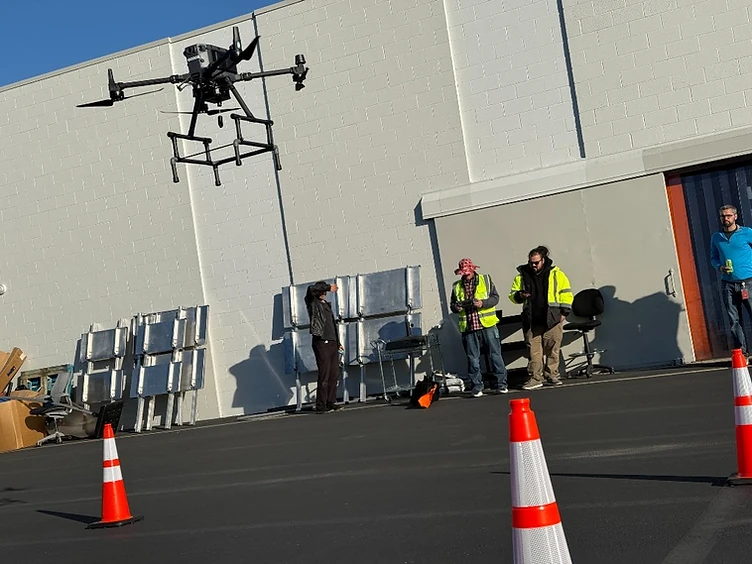
Live flight is not the load-bearing feature. The core Career Exploration experience works in a classroom, gym, restricted-airspace environment, or poor weather.
“Professional UAS work is not defined by controller time. It is defined by the quality of the decisions, teamwork, documentation, and useful results surrounding the flight.”
Knowledge matters. Judgment matters more.
Technical knowledge alone is not enough. CareerVector helps students learn to make thoughtful operational decisions under realistic conditions — through structured scenarios, missions, discussion, documentation, and reflection.
What students leave with.
CareerVector outcomes are authentic, reviewable work products — not generic “skills learned.” Students leave with professional evidence that demonstrates readiness.
Mission Plans
Structured plans that define objectives, crew, equipment, and constraints.
Risk Assessments
Identified hazards with evaluated exposure and recommended controls.
Operational Documentation
Records, logs, and notes that can stand up to review.
Mission Records
A clear account of what was done, why, and what resulted.
Professional Reflections
Thoughtful review of operational decisions and what to change next time.
Portfolio-Ready Work Products
Case studies and project stories an employer or mentor can evaluate.
Readiness Evidence
Authentic deliverables that show professional capability, not just attendance.
More than coursework. A growing record of experience.
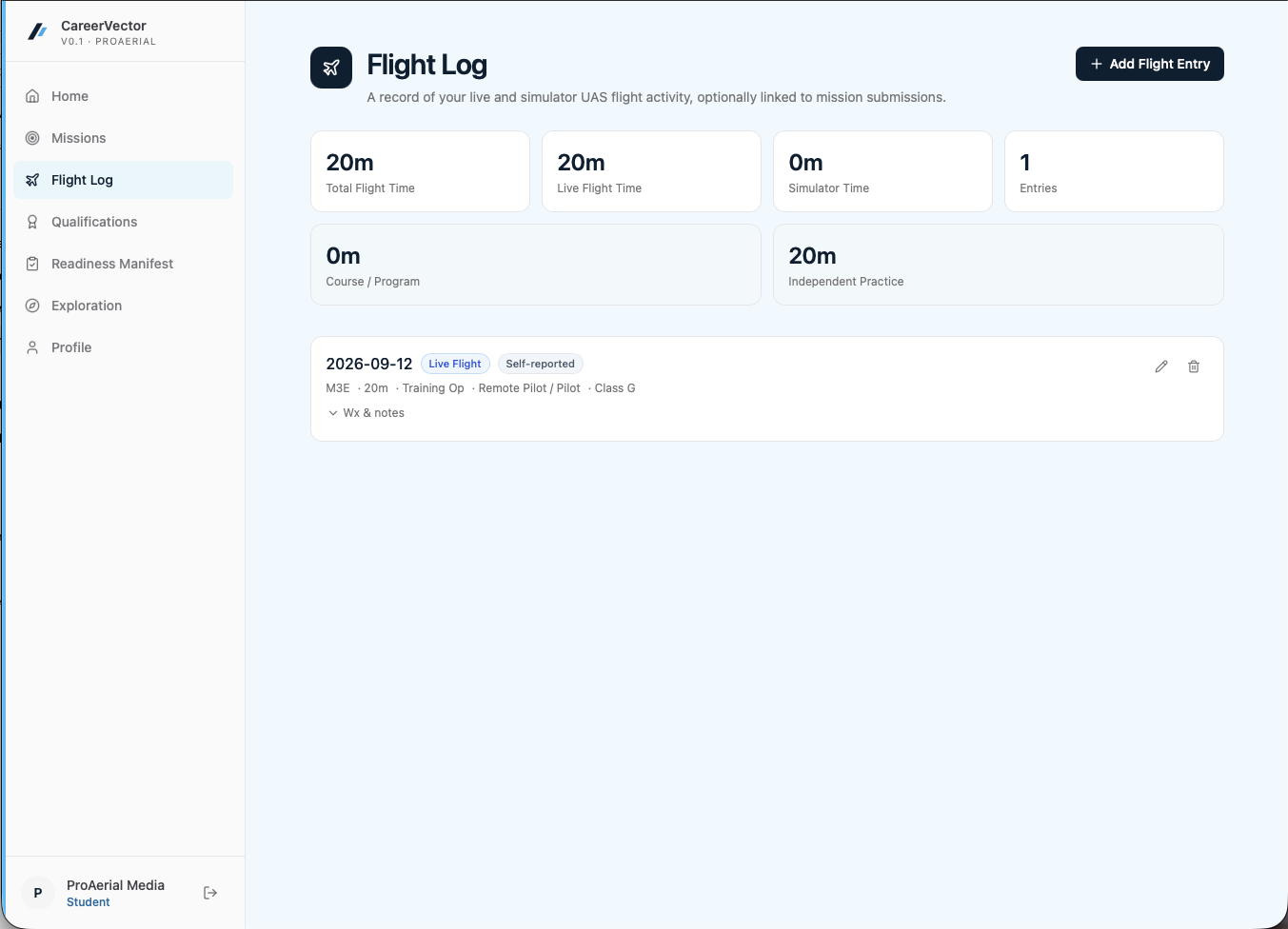
CareerVector gives students a place to connect Mission work, practical flight activity, qualifications, and educator-reviewed evidence as their professional-readiness record develops — not a checklist of completed assignments.
Logged activity is one part of the record. It does not by itself establish proficiency; readiness is demonstrated through mission work and educator-reviewed evidence.
Two complementary paths — not competing products.
107ProPilot builds the regulatory knowledge behind certification. CareerVector builds the professional readiness behind the work. Together they form one connected path from curiosity to industry.

107ProPilot
Build the Part 107 knowledge needed to prepare for the FAA knowledge test.
FAA Knowledge
Earn the Remote Pilot Certificate through the FAA exam.
CareerVector
Develop professional readiness through mission-based learning.
Professional Readiness
Build the judgment, documentation, and operational capability employers evaluate.
Industry
Pursue higher education, internships, mentorship, or employment with credible evidence.
Explore 107ProPilot
107ProPilot is PAM's focused Part 107 learning platform — a separate, optional offering for aspiring and developing remote pilots preparing for the FAA knowledge test.
CareerVector does not guarantee employment, internships, or certification. The stages are a useful progression, not a promise of placement.
Bring a professional UAS readiness pathway to your students.
CareerVector helps schools develop professional readiness, not just drone knowledge. Career Exploration introduces students to professional UAS work and operational judgment. Career Pathway helps prepared learners turn Part 107 study and classroom experience into mission-based practice, documentation, portfolio evidence, and work-ready capability.
- Designed for high-school career fairs, CTE programs, and STEM classes
- Adapted to your facility — classroom, gym, auditorium, or outdoor field
- Aligned with career-readiness and workforce-development objectives
- Delivered by a Part 107 certified remote pilot with real field experience
- Flexible scheduling — single session, multi-session, or recurring program
- Sponsor-supported options available for schools seeking funding assistance
- Hosts may choose either track based on student readiness
- CareerVector complements existing curriculum rather than replacing it
- The core experience remains useful without live flight
- Career Pathway engagements are co-designed around the school's existing program and resources — early engagements may run as pilots or co-design collaborations
What We Need From You
Start where you are — and leave with a credible next step.
CareerVector serves high-school, postsecondary, technical-education, and adult learners. Whether you are exploring drones for the first time, studying for Part 107, already certified, or changing careers, CareerVector helps you build the professional readiness real UAS work demands — judgment, documentation, and operational thinking — and identify a credible next step.
New to drones
Explore professional UAS careers and the mission thinking behind real operations.
Studying for Part 107
Connect regulatory knowledge to real decisions, risk, and operational judgment.
Already certified
Build documentation, deliverables, and portfolio evidence of work-ready capability.
Ready for opportunity
Learn how to explain completed work to mentors and employers in a credible way.
Good to know: CareerVector is an educational, instructor-led program. It is not certification, flight training, a guaranteed live flight, or job placement. To earn the FAA Remote Pilot Certificate, students must pass the Part 107 knowledge test — 107ProPilot is PAM's separate study platform for that.
What parents and guardians should know.
If your student is interested in drones as a professional path, here's how CareerVector works and what it does — and doesn't — promise. CareerVector develops professional readiness; it is not job placement or a guarantee of employment.
Safety and supervision come first
Any flight activity occurs only under certified remote-pilot supervision, with school staff present. No student operates an aircraft without direct oversight.
Educational, not a certification
CareerVector is an educational program. It does not replace FAA certification, formal flight training, or recreational flying instruction.
Professional habits, not flight hours alone
The Pathway Track emphasizes documentation, judgment, and evidence of work-ready capability — not accumulated flight time by itself.
No guaranteed outcome
CareerVector does not guarantee a live flight, internship, or employment outcome. It prepares students to take realistic next steps.
Help build workforce readiness and access for the next generation of UAS professionals.
Sponsorship directly funds professional readiness for students who might not otherwise encounter real UAS work. Partners can support a Career Exploration experience, a Career Pathway engagement, tools and access, or industry perspective — building opportunity and workforce capacity, not just a one-time event.

Sponsor a Career Exploration Experience
Fund a Career Briefing, Exploration Lab, or Exploration Experience for a school or community.
Sponsor a Career Pathway
Support an applied Career Pathway cohort focused on documentation, portfolio evidence, and career readiness.
Support Tools + Access
Provide approved equipment, software access, processing resources, datasets, or other program support.
Provide Industry Perspective
Support mentor conversations, portfolio review, career exposure, or school-controlled work-based learning.
Ready to support CareerVector?
Tell us how you'd like to be involved and we'll follow up within two business days.
Career education from an operator who actually flies.
ProAerial Media (PAM) is a field-proven specialist in professional sUAS operations, safety, and program support. CareerVector is built on the same operational standards PAM brings to enterprise deployments — not theory, not hobby-grade content.
Every session is led by Christopher Kabat, PAM's founder and a working Part 107 remote pilot with years of enterprise field experience across mapping, inspection, and documentation deployments.

Common questions about CareerVector and professional readiness.
Where do your learners want to go next?
Tell us whether your participants are exploring, studying for Part 107, already certified, or ready for applied work. We will help identify the most useful starting point on the path to professional readiness.
PAM is U.S.-based and available for regional, nationwide, recurring, and extended field deployments.