

Operational continuity, codified.
Turris CTRL helps distributed UAS teams keep readiness, risk review, field execution, documentation, and closeout visible across people, sites, aircraft, and missions.
Flight software helps manage the aircraft. Turris CTRL helps manage the operational layer around it.
Flight capability is not an operating system.
Aircraft platforms help control aircraft. Flight applications help plan and execute missions. But distributed UAS programs still need a consistent way to manage readiness, risk review, reporting, follow-up, handoff, and accountability across people, sites, aircraft, and time.
Turris CTRL provides structure around those operational responsibilities without attempting to replace the aircraft platform, mission-planning software, or professional judgment already in use.
- 01Is the pilot assigned and ready?
- 02Is the aircraft, dock, or equipment cleared for use?
- 03Has the site been reviewed?
- 04Have weather, airspace, NOTAMs, and authorization status been checked?
- 05Was a preflight risk review completed?
- 06Did the mission occur as planned?
- 07Is post-flight documentation complete?
- 08Are follow-up items, closeouts, or incidents still open?
Seven workflow areas.
Pre-flight Risk Review
Structured FRAT-style risk assessment before each mission, including airspace, weather, aircraft, site, crew readiness, and mission conditions.
Aircraft and Site Readiness
Verification of aircraft status, battery and firmware considerations, site conditions, equipment concerns, and operational prerequisites before launch.
Daily Operations and Handoff
Operational logging, readiness ownership, shift handoff, field notes, and continuity tracking across multi-day deployments and distributed teams.
Post-flight Reporting
Standardized post-flight documentation capturing mission outcome, flight notes, abnormal observations, aircraft status, and operational notes.
Mission Closeout
Formal mission closure including documentation status, follow-up ownership, equipment disposition, customer-facing notes, and unresolved items.
Incident Documentation
Structured incident and near-miss documentation with follow-up tracking, classification notes, corrective actions, and operational visibility.
Workspace Visibility and Accountability
Centralized operational visibility so leadership, program managers, and field teams can share a common picture of readiness, open items, and closeout status.
How Turris fits into the operational stack
Flight and aircraft software
- —Aircraft control
- —Mission planning and execution
- —Telemetry and payload operation
- —Platform-specific flight records
- —Data capture
Turris CTRL
- —Preflight risk review
- —Aircraft and site readiness
- —Operational context
- —Reporting and follow-up
- —Pilot and shift handoff
- —Mission closeout
- —Program-level visibility
Turris is aircraft-agnostic by design. It supports the people, decisions, records, and continuity around the mission rather than duplicating aircraft-control functionality.
Built for distributed sUAS operations
See the operational workflow
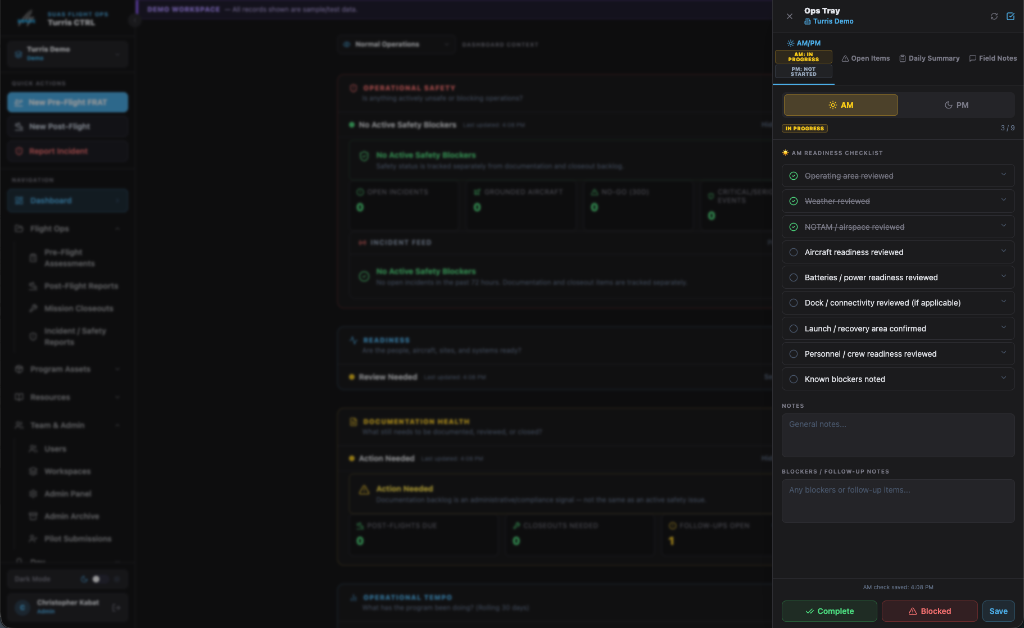
Daily readiness and operational context
A current-state view of workspace readiness, operational signals, AM/PM checks, open items, field notes, and daily handoff activity.
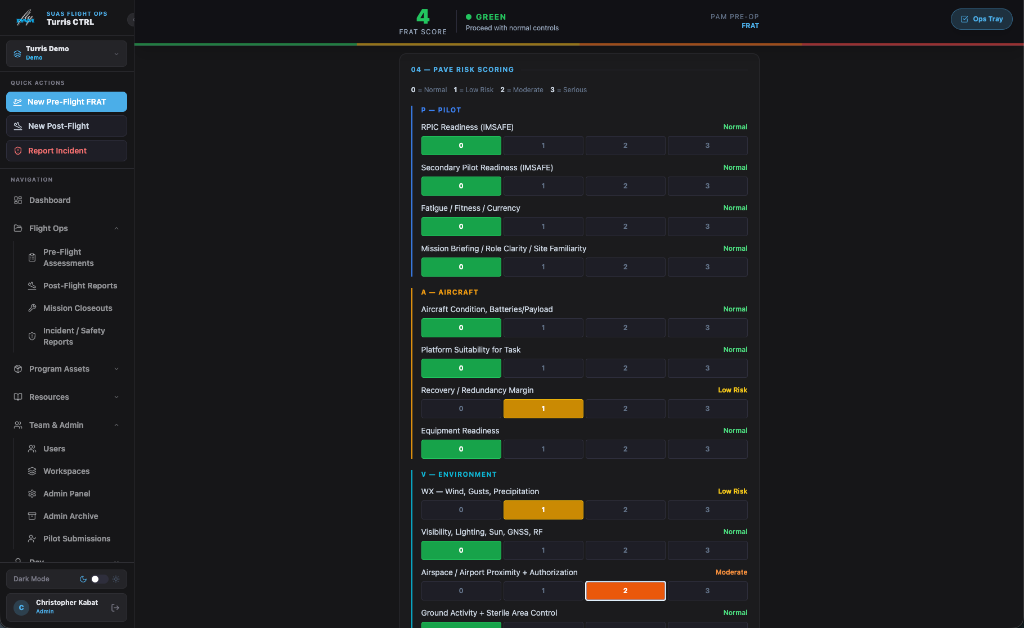
Preflight risk and readiness
Structured review of pilot, aircraft, environmental, airspace, site, and mission risk factors before the final go/no-go decision.
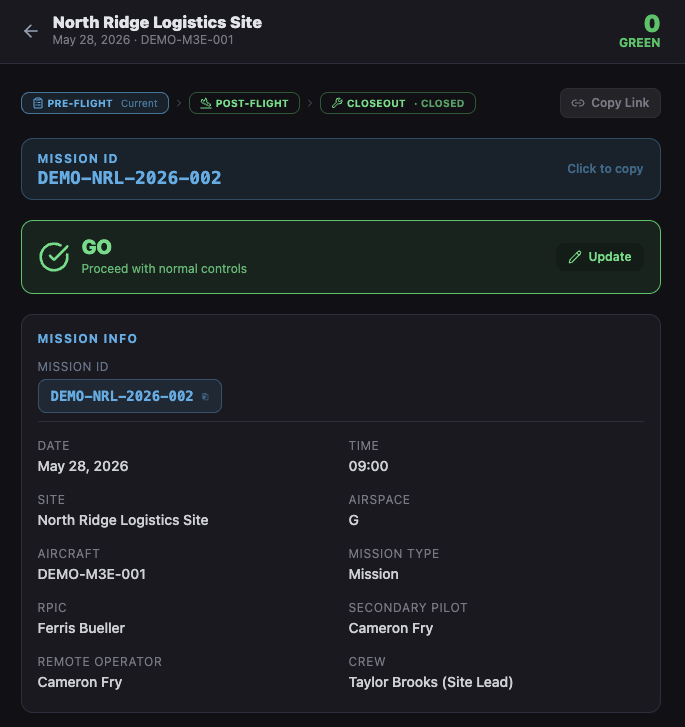
Connected mission record and closeout
A linked operational record carrying mission details, preflight decision, post-flight reporting, follow-up items, and closeout status through one continuous workflow.
Developed around the work between flights.
Turris was developed from real-world sUAS deployments where daily operations required consistent risk review, readiness tracking, documentation, troubleshooting, reporting, handoff, and closeout across changing field conditions.
The system reflects the practical gaps that appear when aircraft, pilots, sites, stakeholders, and operational records must remain aligned over days, weeks, or multiple deployment phases.
Turris is not intended to replace professional judgment. It is designed to make operational responsibilities, decisions, and follow-up easier to see, document, and carry forward.
Read the field case study behind the operational lessons that helped shape Turris CTRL.
View the Field Case StudyWhat Turris is — and what it is not
Turris is
- —An operational continuity system
- —A readiness and accountability layer
- —A structured record of operational decisions and follow-up
- —A workspace for distributed teams and programs
- —A field-informed working prototype
Turris is not
- —Flight-control software
- —An aircraft-autonomy platform
- —A replacement for the remote pilot in command
- —A substitute for organizational procedures or regulatory responsibility
- —A finished enterprise SaaS product
Turris CTRL is a working prototype, not a finished enterprise SaaS product. It is being developed as a field-informed operating model for UAS operational continuity, safety-readiness, and program visibility.
- —Preflight risk review
- —Aircraft and site readiness
- —Post-flight reporting
- —Incident documentation
- —Closeout tracking
- —Workspace visibility
- —Operational dashboarding
Bring more continuity to your sUAS program.
Request an overview of Turris CTRL and discuss how readiness, reporting, handoff, and closeout are currently managed across your operation.